
Modern Slavery in Private Markets: From statements to meeting supply chain management expectations
by Dean Alborough
View post

Climate has been the main character of many sustainability conversations, but nature has always been there in the wings. As Singapore transforms from a Garden City to a City in Nature, the role of natural systems in how we operate, build, and manage risk has become impossible to overlook. The challenge? Nature is complex. In a dense island city such as Singapore, its business links are not always obvious. This is why many organisations assume that nature is not relevant to them, when in reality, connections to nature are woven through their operations and supply chains more than they know.
To foster a better understanding of this concept, we will share a series of articles over the coming months as a follow-up to our Executive Guide to Nature Disclosures. These articles will support companies in Singapore and, more broadly, in Asia as they begin their Taskforce on Nature-related Financial Disclosures (TNFD) journey and showcase how our specialists are helping clients navigate the framework.
This introductory article delves into ‘L behind the LEAP Approach, a framework developed to support the identification and assessment of nature-related issues.
Despite being a heavily urbanised city, Singapore hosts a remarkable range of ecosystems, such as forests, wetlands, seagrass, coral reefs, and mangroves. These ecosystems quietly provide services we rely on every day, such as coastal protection, carbon storage, climate regulation and much more. Ensuring these systems continue for generations is not the responsibility of any one individual, but a collective effort from everyone who depends on or impacts them.
The Taskforce on Nature-related Financial Disclosures (TNFD) provides a structured approach for organisations to understand and respond to their nature-related risks and opportunities. Its LEAP approach begins with Locate, which identifies where your organisation’s activities interface with nature, and enabling you to confidently prioritise the focus areas for the ongoing assessment.
To help you get started on your TNFD journey and bring the ‘Locate’ step of the LEAP framework to life, we use the example of a fictional Singapore-based construction company, BuildGood Pte Ltd. This example walks through practical considerations and actions BuildGood might take to uncover their nature-related dependencies and impacts.
A starting point for BuildGood would be to map out its value chain. This includes upstream, direct operations, and downstream operations, and for each stage, asks the question, “Where do we depend on nature and where might we impact it?”
If you are drawing a blank, start by exploring publicly available resources and data you already have access to, such as:
Below is an expanded example of how BuildGood, given its reliance on steel, might begin mapping its value chain against key drivers of nature loss.
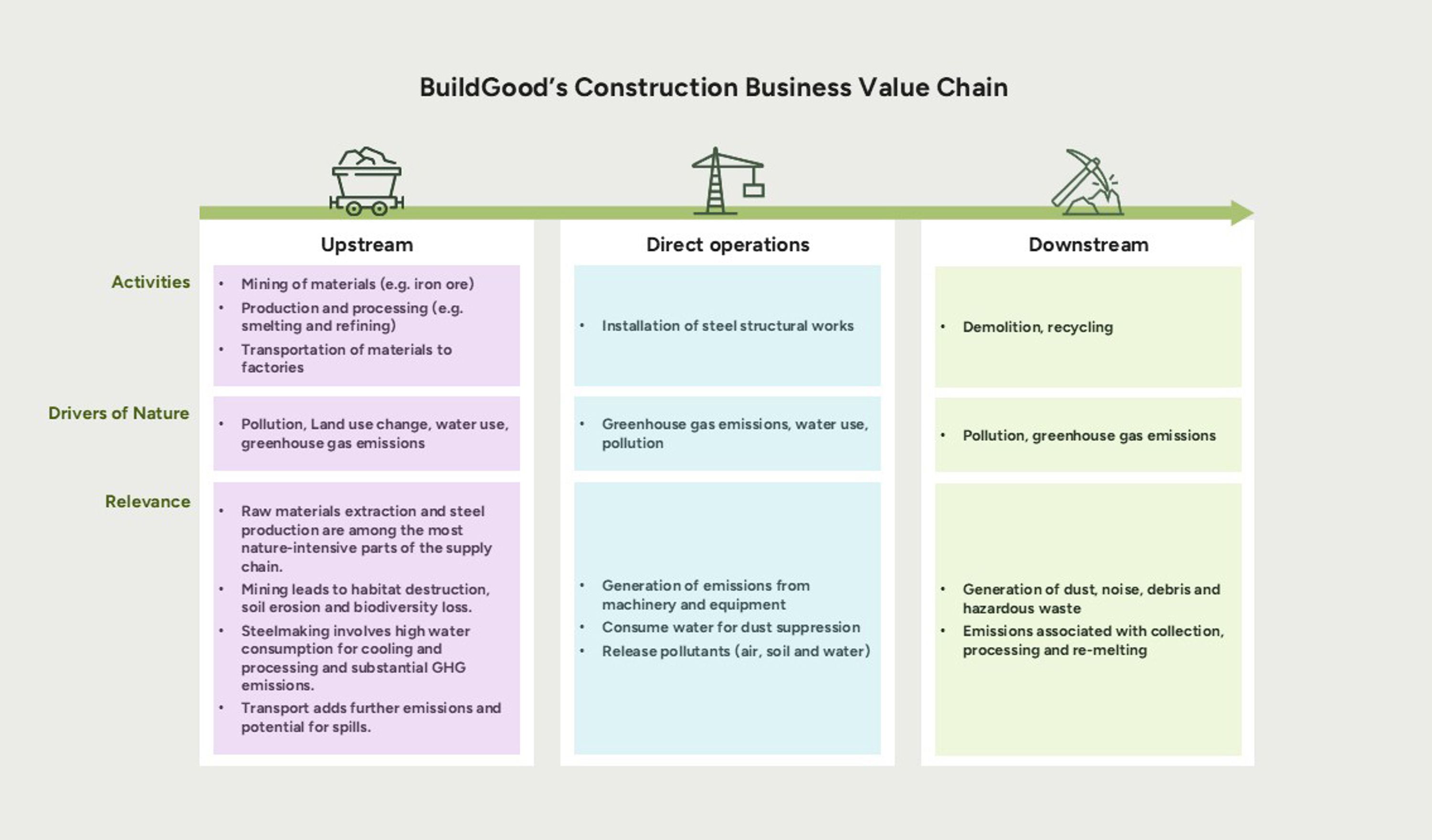
‘Locate’ focuses on identifying where your organisation interacts with nature, and this is often a step that many companies struggle with. Common questions arise, such as “How far up the supply chain should you look?” or “How far downstream does my responsibility go?”
By breaking the process down and reviewing each component systematically, you can move forward in a practical, structured way:
With the totality of the organisational interface with nature identified, companies can then prioritise the focus area for the rest of the LEAP assessment.
That may mean focusing on the areas with the most impact, or for companies with limited resources they may choose to focus where they have the best data, or the most direct influence. Companies may choose to start with a single product line, or business unit, to test their approach and readiness, before rolling out the assessment more widely.
SLR supports organisations at all stages of their nature journey. From identifying their nature interface and material impacts to clarifying strategic priorities, developing nature and biodiversity strategies, enhancing disclosures, and implementing site‑level action plans that deliver measurable outcomes for climate, nature, and people.
To speak with one of our specialists, contact us today.
Stay tuned for our next article in the series, where we’ll further unpack the TNFD LEAP Approach, this time exploring what ‘E and A’ mean and how they guide your journey.
In the meantime, catch up on the articles below to learn more about the support and solutions our specialists are providing clients navigating the framework: