Why better sustainability decisions depend on better data
- Post Date
- 13 August 2026
- Read Time
- 10 minutes

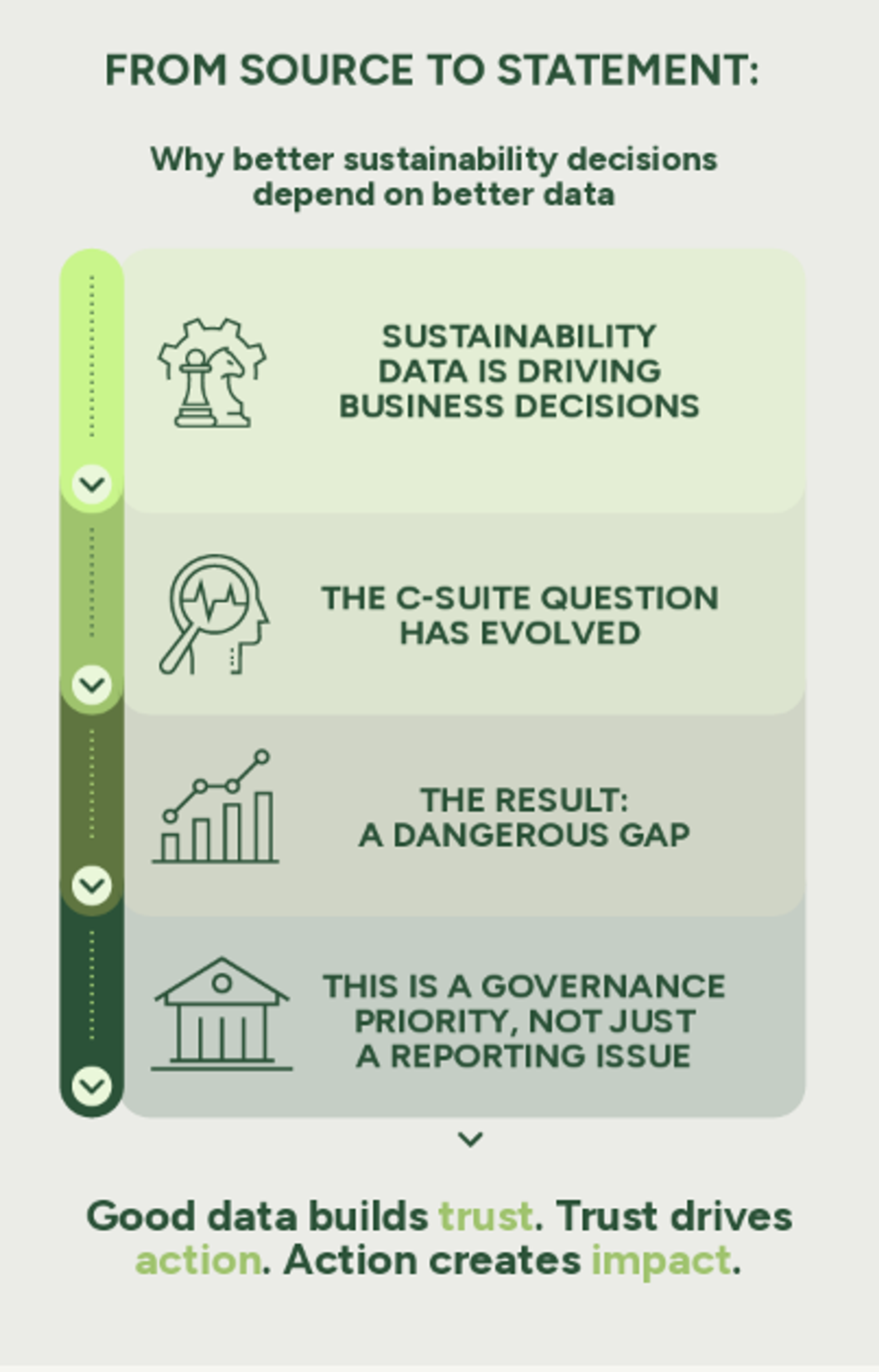
Not long ago, sustainability reporting was largely about disclosure – publishing enough information to satisfy investors, regulators, and other stakeholders. Today, the conversation has fundamentally changed: the data might look complete on a dashboard, but is it strong enough to support confident decision-making?
This matters because sustainability information now carries more weight. Investors are asking better questions. Regulators are raising expectations. Customers want proof, not broad commitments. Boards are expected to understand how sustainability risks and opportunities affect enterprise value.
Before presenting to executives, the team should ask: Are we measuring the right metrics? Can it be traced back to a credible source? Has it been tested? Are the assumptions clear? Are the limitations understood? Has management reviewed what the data is actually saying? Would the information withstand independent assurance? And, perhaps most importantly, is the data good enough to guide action before it becomes a disclosure issue? In the following paragraphs, we outline the pitfalls of data assurance and explore what defines decision-grade data, which guides action before it becomes a disclosure issue.
Trust has become the new currency of corporate reporting
Many sustainability claims start their life far away from the final report. They may begin with a supplier interview, a worker record, a site visit, a chain-of-custody check, a contractor agreement, an environmental control, a grievance log, a wage record or a corrective action plan.
By the time this information reaches an executive dashboard, much of its original context may have been lost. A finding becomes a score. A score becomes a trend. A trend becomes a statement. A statement becomes a disclosure. The problem is that each step can either strengthen or quietly weaken the evidence. If the first data point is incomplete, unclear or poorly tested, the final claim is already compromised. The report may still read well, but the decision behind it may be exposed.
Many clients and their financiers say allegations of greenwashing are among the greatest reputational risks facing organisations today. Sustainability claims that cannot be supported by robust evidence are increasingly challenged by regulators, investors and civil society. Common examples include overstated recycled content, unsupported ‘carbon neutral’ claims, selectively reporting favourable metrics while omitting poor performance, excluding underperforming operations from reporting boundaries, or changing methodologies without adequate explanation. In every case, the issue is the same: trust is lost when the underlying data cannot withstand scrutiny.
What we call the golden thread of statement
In sustainable sourcing and assurance work, we see this clearly. The final sustainability statement may sit in an annual report, investor pack, customer response or public disclosure. But the evidence that supports it often starts much further upstream, across suppliers, contractors, farms, factories, mines, logistics providers and local operating sites.
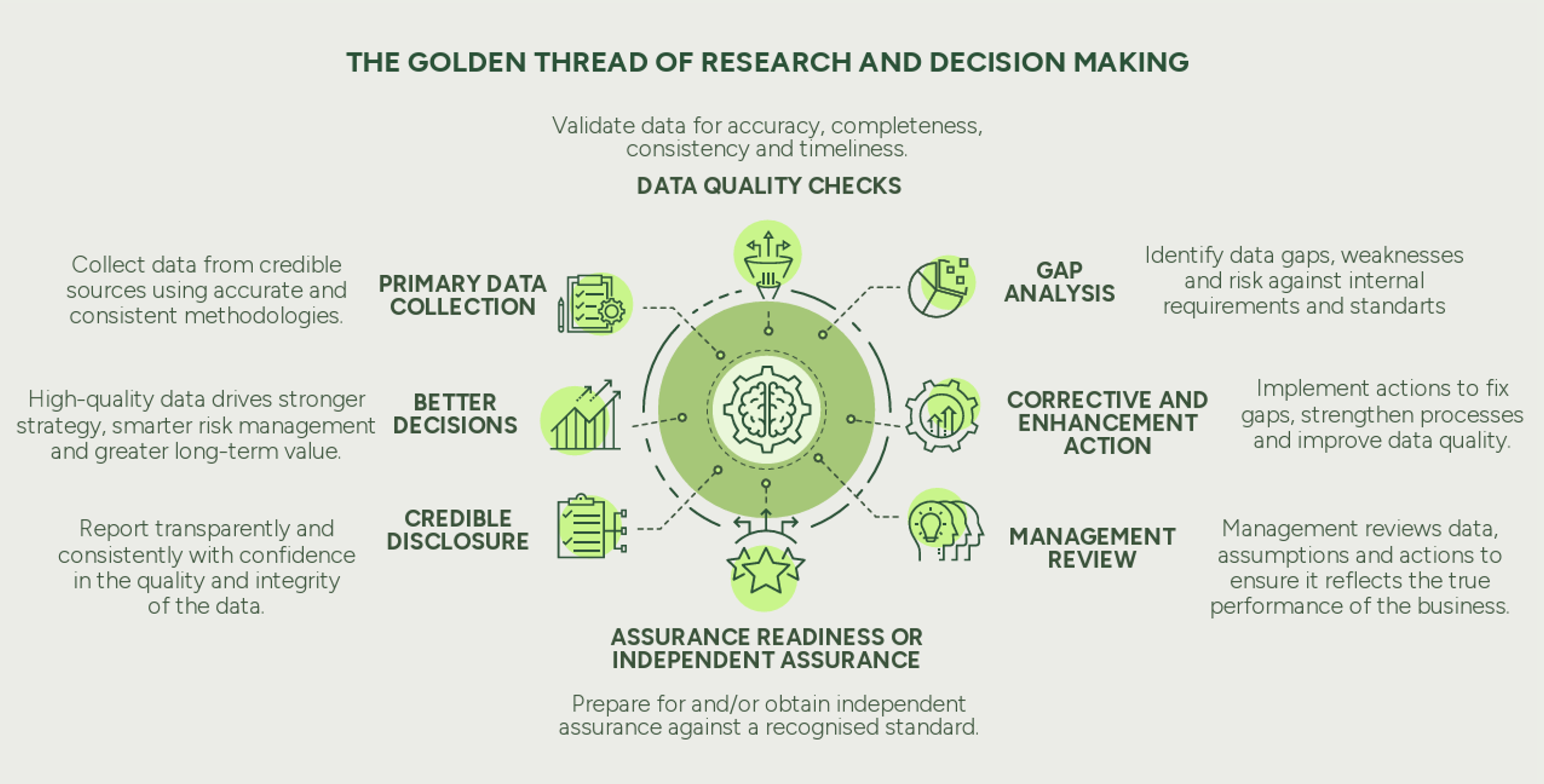
The golden thread is the connection between what is happening at the source and what is said at the top of the organisation.
The golden thread of decision-grade data
Ambition setting → scoping business indicators → primary data collection → data quality checks → gap analysis → corrective and enhancement action → management review → assurance readiness or independent assurance against a recognised standard → credible disclosure → better decisions.
This should not be misunderstood as a single fixed process. Sustainable sourcing does not automatically produce assured data. A supplier assessment, by itself, does not make a disclosure credible. Assurance also does not create good data at the end of the reporting cycle. It tests whether the information, systems and evidence are strong enough to support the claim.
The value lies in understanding how the parts connect: a supplier assessment that does not consider current disclosure requirements or does not anticipate important upcoming needs may collect the wrong evidence. A disclosure process that does not understand source-level realities may overstate what the business can safely claim. An assurance process that starts too late may identify weaknesses after the reporting timetable has already closed.
Consider a blended example from work typically undertaken across sustainable sourcing, responsible procurement, management systems and sustainability assurance.
A large organisation operating across multiple sites and supplier categories wants to understand whether its responsible sourcing commitments are supported by evidence. It has policies in place. It has supplier requirements. It has internal reporting structures. It also has public sustainability commitments that matter to investors, customers and the board.
At first glance, the organisation appears to have the right architecture. But the real question is whether the system works. And that requires going beyond policy review.
It requires primary data collection: interviews with management and workers, supplier engagement, contractor document reviews, wage and working-hour checks, assessment of recruitment practices, review of environmental controls, site observations, grievance mechanism review, chain-of-custody checks and testing of corrective action evidence. It's also about identifying meaningful trends or issues rather than an obsessive focus on completeness. It also requires interpretation. And eventually, being aware that gaps are not forever, as improvements are always incorporated into the next reporting cycle.
The business can start asking precise questions. Which suppliers need immediate engagement? Which findings indicate isolated gaps, and which show system weaknesses? Which risks are material enough to reach executive level? Which data points are strong enough for disclosure, and which still need improvement? What evidence would be required for assurance? What should management act on now?
This is the practical value of the golden thread. It turns raw data into management information. Data collection, sustainable sourcing, disclosure preparation and assurance are often treated as separate disciplines. In practice, they influence one another.
And this is also where integrated advisory support becomes important. The strongest support comes from understanding how data is created, how it is tested, how it is interpreted and how it will eventually be disclosed or assured. A board does not need to inspect every payslip, supplier agreement or site photograph. But it does need confidence that the business has a credible process for knowing what is happening, testing the evidence and acting on the results.
Great data is not perfect
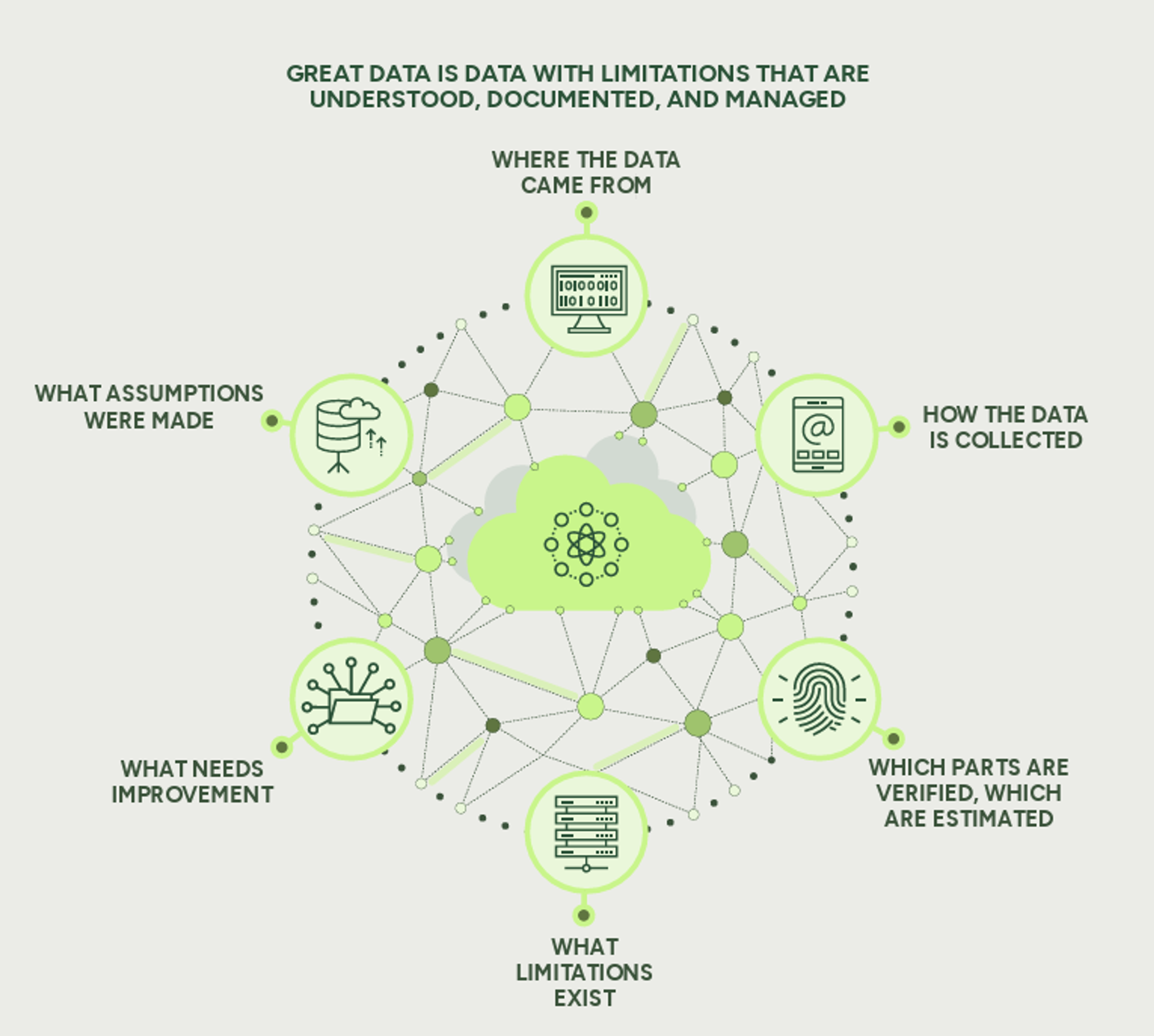
Great data is data with limitations that are understood, documented, and managed. It’s allowing companies to say exactly what they can evidence.
In complex operating environments, perfect data is rarely available. Suppliers change. Contractor workforces fluctuate. Records may be inconsistent. Some indicators require judgement. Some risks are visible only through interviews, observation and triangulation. That means being clear about scope, sampling, methodology, assumptions, exclusions and evidence quality. It means distinguishing between verified data, estimated data and management representation. It means recording exceptions. It means knowing where data was collected, who collected it, which evidence was tested and what follow-up is required.
By contrast, organisations that continue to rely on disconnected systems, manually maintained spreadsheets, inconsistent approval processes, weak change management practices and limited segregation of duties remain exposed to significant reporting risks. These weaknesses increase the likelihood of inaccurate or inconsistent ESG information, making companies vulnerable to regulatory findings, assurance qualifications and reputational damage.
To the sustainability and ESG teams, the executive ask should be fairly straightforward: not more data, but better data, especially where it influences procurement, capital allocation, customer claims, investor messaging, risk management or public disclosure.
And then the challenge they should raise is: Where is the source evidence? A dashboard is not evidence. A policy is not evidence. A supplier declaration is not always enough. Material claims should be traceable to underlying records, sitelevel evidence, interviews, management review and corrective action where relevant. If the business cannot explain the methodology, assumptions, evidence trail, controls and limitations, the data is not yet assurance-ready.
These questions help shift ESG data from a reporting exercise to a management discipline. Testing and correcting is easier to describe than to do. The common pattern is familiar: a business identifies a long list of energy and carbon reduction opportunities across its sites, publishes the headline number, and moves on to the next reporting cycle.
The stronger approach is to treat that list as a hypothesis rather than a result, and to go back more than once to check what actually happened on the ground. Some opportunities will be confirmed complete. Some will still be in progress. Some will turn out not to be feasible at all.
The same discipline applies to how reductions are described: those built on proven technology should be separated from those dependent on emerging or unproven ones, and any variation in site level documentation should be acknowledged rather than smoothed over. Where assurance is limited rather than reasonable, the business should say so plainly.
Investors do not read this as weakness. They read it as evidence that the data has been tested, revisited and corrected. A transparent statement that makes the rest of the data trustworthy.
From disclosure burden to strategic advantage. The strongest businesses do not treat sustainability data as an annual reporting burden. They will treat it as a strategic asset. These organisations distinguish themselves by:
- Establishing clear ownership, accountability, and governance for ESG data across the business.
- Automating data collection directly from operational systems, reducing reliance on manual spreadsheets, and eliminating unnecessary data transfer points that introduce errors.
- Developing comprehensive reporting methodologies and guidance to ensure consistency across business units and geographies.
- Embedding robust internal controls, supported by documented audit trails that enable complete traceability of reported information.
- Regularly testing data quality, identifying weaknesses, and implementing timely corrective actions.
- Being transparent about estimation uncertainty, assumptions and methodological changes.
- Obtaining independent assurance over key ESG metrics to provide stakeholders with additional confidence.
In our day-to-day work with clients, we recognise that these points convey the real value of the golden thread: it shows that when primary data collection is designed well, tested properly, translated into corrective and enhancement action, reviewed by management, and prepared for assurance, it becomes much more than a reporting input.
For organisations serious about strengthening disclosure and investor confidence, the next step is to incorporate a discipline of testing, correcting and testing again. As we like to say in our assurance projects, make sure your data is good enough to carry the decisions being placed on it.
Advisory Digest
Enjoyed this article? For more like it, get SLR's quarterly sustainable business briefing straight to your inbox.
Sign Up
Recent posts
-
-
Why better sustainability decisions depend on better data
by Simon Clarke, Johan Oosthuizen, Petrus Gildenhuys
View post -